

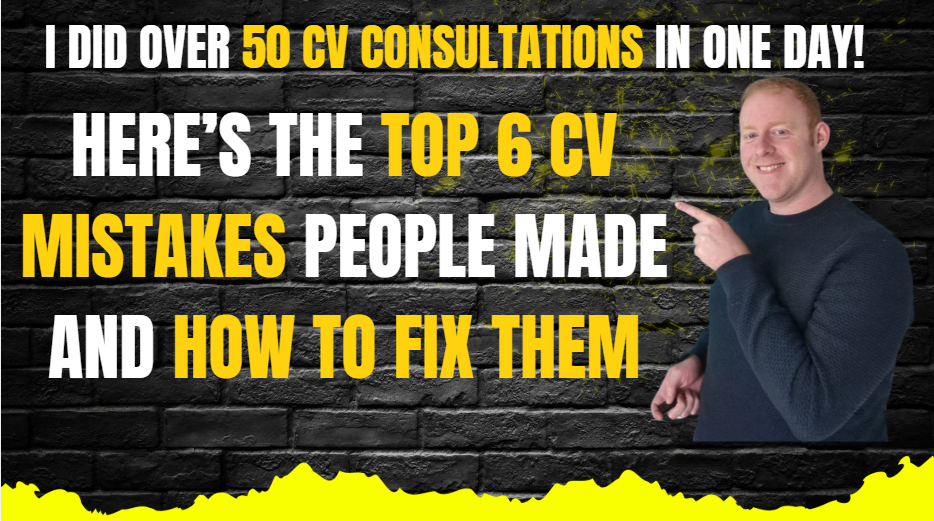
Last week, I was down in Dublin at the Career Connect event acting as a panellist and CV reviewer.
In just one day, I personally held over 50 CV consultations for a wide range of experienced professionals.
It was an exhausting but eye-opening experience that put me right into the mindset of a recruiter and hiring manager.
Reading that volume of applications back-to-back makes patterns jump out at you very quickly.
I noticed six major themes that are consistently holding brilliant, experienced people back from landing interviews.
If you feel like your CV is disappearing into a black hole, let’s reframe how you approach your layout.
1. Hiding your industry expertise
Most professionals focus heavily on listing technical skills, systems, or methodologies.
But they completely forget that their specific industry experience is a massive asset in itself.
If you have deep knowledge of financial services, retail and hospitality or pharmaceuticals, treat that context as a core skill.
It is exactly what makes your background unique and helps you stand out to the right hiring manager.
2. The identical template and column trap
Recruiters get incredibly tired of looking at the exact same rigid, black-and-white layouts all day.
Injecting a subtle touch of colour, like a navy heading or a clean banner, makes the document instantly more visually inviting.
However, please keep your layout strictly left-to-right and avoid using split columns.
Applicant Tracking Systems (ATS) often struggle to read columns properly, and humans naturally read from left to right meaning they might miss some of your experience.
Also, don’t panic about squeezing everything onto one page; a full two-page CV gives your experience the room it deserves.
Check out what I mean by accessing my free CV template too see what I mean.
3. The AI copy-paste giveaway
I use AI tools within my own CV writing process, but there is a right way and a wrong way to do it.
The moment a CV opens with “a results-driven, dynamic professional who is detail-oriented,” a recruiter knows it is generic AI output.
Another massive giveaway I noticed last week was American spelling creeping into CVs for UK and Irish roles.
Look out for robotic phrasing and formatting quirks that you would never naturally type yourself.
Write the core of your CV in your own authentic words, and use AI purely for feedback on what might be missing.
4. Layouts that bury your value
A recruiter typically takes just six to eight seconds to decide if they are intrigued enough to keep reading your profile.
Because of this, your core skills section needs to sit directly underneath your brief personal summary at the top.
Too many people hide their hard-earned skills right at the very bottom of the second page.
Make it effortless for the reader to see that you match the job description the second they open the file.
Follow this with your chronological work experience, and leave your formal education section at the very bottom.
5. Missing company context
Many professionals dive straight from a job title into a dense block of bullet points about their duties.
Without context, a hiring manager cannot appreciate the true scale and scope of what you actually achieved.
Add a brief two-line introduction directly under your job title before you list any bullet points.
Explain exactly what the company does and define the scope of your specific business unit or team.
This sets the stage beautifully and gives your achievements the weight they deserve.
6. The personalisation trick nobody is using
Out of more than 50 CVs I reviewed on the day, not a single person was doing this.
To leave an unforgettable first impression, customise the very final line of your personal summary for the specific role.
Explicitly state how your target skills align with that exact business.
For example:
“I look forward to applying my skills in workload prioritisation and stakeholder management to become a project manager at Company X.”
It takes less than two minutes to alter, but it instantly proves to the employer that you have genuinely read their job description.
Reviewing your own career history objectively can be incredibly difficult when you are simply too close to it.
Good luck with your job searches this week, and if you’d like to learn how I can help you further, Book a free, no-obligation 30-minute consultation with me and tell me your story.
Let’s see if I can help you shift the dial and secure your new career.